Hello and welcome to my blog! My name is Caroline and I am a PhD student at the University of Sheffield. My research project focuses on Striga - a genus of parasitic plants that devastates harvests by infecting food crops. I am exploring the defence reactions that can make host plants more resistant against Striga. Due to my ongoing battles with anorexia, I haven't made as much progress as I would have liked but I am determined to finish the course.


This blog charts the ups and downs of life in the lab, plus my dreams to become a science communicator and forays into public engagement and science policy....all while trying to keep my mental and physical health intact. Along the way, I'll also be sharing new plant science stories, and profiles of some of the researchers who inspire me on this journey. So whether you have a fascination for plants, are curious about what science research involves, or just wonder what exactly I do all day, read on - I hope you find it entertaining!


Friday, 10 April 2015

Gatsby Training Weekend 2015 - Day 1 Friday 10th April

Is it always sunny in Cambridge? Or was the weather just matching my mood as the train sped me southwards for the annual Gatsby Plants Training Weekend. I was looking forward to catching up with my fellow students in this network, which was originally founded to encourage young researchers to enter a career in the plant sciences. Each year, the undergraduates and PhD students of the Gatsby Plant Network are invited to Jesus College in Cambridge for a weekend of career development and training activities. I knew from last year that this wasn't going to be a holiday - they really know how to pack a lot into two days!

After a welcome cup of tea on arrival, the programme got underway with the first item being the student presentations. We each had to prepare a PowerPoint presentation, 8 minutes long with 4 minutes for questioning. These days, being able to give a presentation is just as important a skill for biologists as handling a pipette - more so for some! Usually, the talks are given alphabetically by speakers, so I am the last to go, but this year the organisers had decided to mix things up a little and I was first. This was probably a good thing as my nerves had less opportunity to build up into a panic... Although public speaking is something I do get nervous about, I welcomed this valuable practice to present before such a supportive audience. But knowing these talks are recorded for David Hanke's video archive of student presentations adds a certain aspect of pressure! You never know when he will dig out some footage of you to critique during his 'How ( not to ) give a Talk' sessions!

I had braced myself for a slew of technical questions but fortunately, many people seemed curious about my rhizotron system for growing plants so I was able to go into quite a bit of detail about this. I forget that they are quite unusual! Amongst the other talks, I was intrigued by Jakob Assman's presentation describing his project on Phytophra austrocedri, an oomycete pathogen that is a scourge of cypresses in Argentina and is now starting to attack junipers in the UK. But would this worry people as much if it didn't threaten the gin industry?!
The beautiful grounds of Jesus College , Cambridge

The talks over, we could then relax as our 'Before-Dinner Speaker' Deborah Charlesworth took to the lecturn ( we had voted for a before-dinner, rather than after- dinner speaker at the end of last year's weekend - it was generally agreed that it is more difficult to concentrate after copious amounts of fine wine and food had been consumed...). In her talk 'The Role of Science in Society' , Deborah described how too strict a focus on applied results can suffocate the love that draws researchers to their chosen field in the first place. Her career itself is a fitting illustration of a livelihood forged by following one's curiosity. Although perhaps best known for her work investigating plant sex chromosomes, Deborah 'came to plants in a very roundabout way'. Indeed, she originally graduated in Biochemistry and had hated drawing floral diagrams at school. But she was drawn into biology when she moved to a new area with her husband and 'started helping out in a laboratory because I was sitting in the flat, bored'. Here, she was investigating the genetics in Papilio butterflies that allows them to mimic the appearance of distasteful species. Although several physical changes - such as colour and wing shape - are required for each case of mimicry, the data suggested that these are brought about by a single set of linked genes, rather than multiple genes scattered throughout the chromosomes. This seemed improbable because, during cell division to produce new eggs/ sperm, the chromosomes undergo rearrangements ( meiotic recombination) that can split up closely situated genes. For the butterflies, this recombination would break up the mimicry phenotype. However, Deborah was able to help show that certain 'modifier' genes were acting on the DNA to suppress recombination events and keep the phenotype intact. Building on this work, she then went on to investigate plant sex chromosomes. Although the majority of plants are 'dioecious' ( meaning that they have both male and female parts), a handful are 'monoecious' - they have single sexed individuals- and these include kiwi, papaya, hops and asparagus. It is now thought that similar 'modifier genes' prevent recombination events in these plants that would disrupt the male and female phenotypes. 

Relating back to the title,of the talk, Deborah made the point that, just as she 'fell into' a career in plant science research quite by accident, sometimes scientists should be given the space to simply follow their own curiosity. Quoting Ogden Nash, she remarked 'Progress was a good idea once, but perhaps it has gone on too long'. These days, it can feel that we are 'being administered by the administrators of science'. But politicians and policy makers can be so focused on 'gathering facts' that they forget that there is 'a very intimate connection between pure and applied science'. Rather than being in a rush for results, we should value 'slow science'. In Deborah's view, cutting off pure research is akin to killing the goose that lays the golden eggs as it effectively cuts off the root that leads to beneficial applications. Furthermore, she argued that 'taxpayers themselves aren't just focused on results - they DO love flowers...and animals, plants, natural history...' After all, these are some of the most popular subjects for TV programmes! Scientists themselves have to have a love for their work and chosen organisms to study - it would be impossible otherwise to survive the ardour of a PhD or the multiple demands of being a Lab Group Leader...

Perhaps in the future we could try to strike a balance somewhere? Applied science may always be the key attraction for industry and funding bodies but maybe we can start to find room for a little more...love...in our science? 

Plenty of food for thought as we adjourned to the Upper Hall for our formal dinner. Tonight we enjoyed Asparagus soup with walnut oil followed by a pillow- sized breast of duck accompanied with yet more asparagus ( was there a glut in the Jesus College allotments?) and a mini gauge tower of potatoes. Many agreed that the pudding was the most impressive in appearance (see below), although, in my experience, a mouse should be more,like foam and less like rubber in consistency...at least it gave something for the pineapple tuile to,dig into! At this point, I was quite ready for bed so cannot regale you with merry stories from the vaults of Cambridge's' finest pubs....Goodnight!
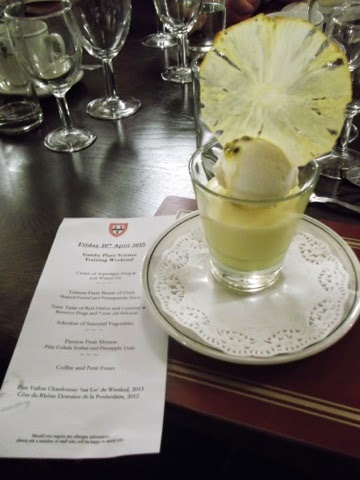
Passion Fruit 'Mousse' with PiƱa Calada Sorbet and Pineapple Tuile

Quote of the day: From a student given just two minutes notice that he would be introducing Deborah Charlesworth: 'Deborah Charlesworth...yeah...she's a giant...'

Wednesday, 1 April 2015

Trying times

'These tubes WILL drive you mad!' My second supervisor laughed as I failed, yet again, to roll the flimsy plastic into a tube. And why was I attempting to wrap cellophane around my Arabidopsis plants, turning them into a mad parody of a ornamental carnation for a florist? The answer : it is, apparently, the easiest way to collect seed from a flowering Arabidopsis to stop it getting mixed up with that of others.

I am nearly ready to use my interesting defence-signalling mutants for my first infection assay with the parasitic weed Striga gesnerioides. These could provide a clue as to what defence pathways in the host plant's immune system have a role to play in a resistant interaction. But first, I have to bulk up the seed for each mutant line, so that - if I find anything interesting- I can put on a very big experiment to collect some concrete data. But as these mutant lines each have different genes knocked out, it is ESSENTIAL that I keep the seed separate and carefully labelled so I know what is what! Hence the tubes: these should keep the flowers separate, preventing cross- pollination, and the seed should fall into the plastic bases where I can collect it later.

That is the idea anyway.


I don't think I can count on being a florist if the PhD doesn't work out, as it takes me an age to wrap and set up all my tubes. It sums up the general way of my work at the moment, with quite a few frustrations. After Striga failed to infect my first tobacco plants, I have the second attempt now underway: hopefully the combination of using a sandier soil mixture, a cooler growth chamber and more nutrient solution will do the trick this time. I have also swapped over my growth chambers this week, switching the long day ( 16 hours of 'daylight') to short day ( 9 hours of light) and vice versa, to give me more space for my infected rhizotron systems. So that was a stressful day heaving all my plants about! At least the cabinets are on the same floor! 

Today we had our first lab meeting for a while which resulted in more work for me, and all of us in the lab. The potting area in the annexe, where we keep our plants, is in disarray and we have all been told to keep on top of it and make sure it is tidy. We all received an email saying that 'an improtant guest' is coming to look round next week , so that will give an incentive! Our supervisor has also decided we need a rota to clean the big growth chambers full of the rice, maize, tomato, etc that the rest of the lab work on. Fortunately, as I don't really use these chambers, I haven't been out on the rota but instead I need to keep my two growth cabinets clean. Which is very tricky when the non- adjustable shelves have a good gap between them where the dust and dirt catches! I am thinking of investing in a little vacuum cleaner... But it is all part of the usual problem solving that being a researcher is all about.

Thursday, 26 March 2015

Every PhD has ups and downs...and this is surely a down...

In the fridge next to my lab, there is a very special glass vial. It contains seed of the parasitic plant Striga gesnerioides - a major pest in sub-Saharan Africa and the focus of my PhD project. 
And it is the only vial of seed we have in the lab. My problem: it is running out fast.

Research scientists aim to preempt such problems like these. Hence, several months ago, I transplanted some young tobacco seedlings into pots of soil infested with S. gesnerioides. The idea was that the parasite would infest the tobacco, send up a forest of flowering shoots and produce enough seed to see me through to the end of my PhD. First signs were hopeful, with one or two flowering Striga shoots emerging from the soil ( see the post ' Wait and it will come'). 
But then... Nothing. No more shoots. I began to panic - was this it? Were these few shoots just extremely early and it was only a matter of time before the rest emerged? But then the few shoots that had appeared shrivelled to nothing, turned black and died. So here I am , months later in the same position,with no new seed. 


What happened? My supervisor has two main theories. The first: the pots the tobacco plants were planted in were too small, so the roots would have been compacted together so densely, that the parasitic shoots wouldn't be able to force their way through. Second: the tobacco plants didn't get enough nutrients so couldn't supply the parasite with enough sugars to fuel reproductive growth. Thirdly, it is simple too hot in the greenhouse!

So tobacco two, the next generation, are ready for another go. This time I will be planting them in a peat/ sand mixture, to hopefully encourage the roots to grow in a looser network, making it easier for the parasite to emerge. I will also be growing them in a smaller conviron growth chamber, rather than the greenhouse chamber, and supply them a special nutrient solution.

Fingers crossed! In my works at least, there is a lot at stake!  

Wednesday, 18 March 2015

So long and thanks for all the seed...

When I tell people that I am a plant scientist, they are generally aware that this means I spend a lot of time growing things. What they don't perhaps appreciate is that I also spend a lot of time destroying things. Clearing out Infected Arabidopsis plants ( and cleaning all the RHIZOTRONS afterwards)  is one of my least favourite jobs and this week it was the turn of my first tobacco plants to face the chop. My beautiful tobacco plants - almost as high as I am and brightening up the drab growth chamber with their abundance of pink and white flowers - had only been brought into existence for one purpose; to become seed factories. I had originally been sent a small vial of tobacco seeds as a gift from a mentor at Durham University, where I completed my undergraduate degree. I wanted the tobacco in the first place to act as a susceptible host for Striga gesnerioides, the parasitic weed I am working on. But I am fast running out of Striga seed so the idea was to infect some tobacco with the Stiga parasite, which should send up a forest of flowering shoots and produce enough seed to see me through the rest of my PhD.

But first, I needed to bulk up the stocks of tobacco seed itself, as I had only the one vial from Durham. Hence, these plants were left to grow marvellously tall, flower and bring forth seed pods , which I harvested last week. It was easiest to stand the tobacco on the floor to get to them!


Seeds collected, they had now served their purpose. Besides this, they were taking up space and had become infested  with flies - bad news in a growth cabinet chock full of other people's experiments! So my supervisor ordered me to clear them out. It was a sad afternoon reducing my tobacco forest to several bin bags. But it is all part of research. As a colleague said 'at least you don't work on mice'.


But, in a key sense, my tobacco live on.... In the vials of new seed now on my bench shelf. And it is good seed- I planted a few to test the germination rate and every seed sprouted into a new seedling. Hello tobacco generation 2!


Sunday, 15 March 2015

It takes HOW MUCH to grow a lettuce?!!!!


I recently attended a training workshop on 'How to become a Food Champion', hosted by the University of Sheffield's food sustainability group, Sheffield on a Plate. Amongst the various intriguing stats , one in particular seemed to hit me across the face:

'The environmental impact of throwing away a lettuce is 100 times greater than the impact of throwing away the packaging it came in'

I had always believed that packaging had a key role when adding up the environmental costs of our food. Hence, I always avoided buying pre-wrapped fruit and veg from the supermarkets, taking my own bags down to the market instead to fill up with loose produce. But it seems I had my values confused.

To me, this startling fact raises two questions. Firstly - when did we stop valuing food as we should? It is a struggle to comprehend how far removed we are from the natural 'status - quo' where we would only be able to eat what we could hunt and kill, forage for or scavenge from other animals. Now we delegate food production to others, and expect it to be laid out for our convenience - but we still moan about the time and effort it takes to shop for it all! We are very sensitive to when food prices rise, but perhaps we have forgotten just how much labour, land and thorough care goes into producing our food. And not just any food - healthy, rigorously checked and nutritious food, for the main part sourced with care, at a standard many nations can't afford. 
It saddens me when supermarkets try to tempt us with bulk bargains into buying more than we can possibly use - as though the most important thing is to clear it off their shelves. But individual responsibilities count too - it depresses me to see so many half eaten takeaways simply jettisoned on the kerb when I walk into work in the morning.
The Love Food, Hate Waste campaign would be delighted to help you minimise your own food waste. This is not the place to lecture, so I will refer you to their excellent website: 
http://www.lovefoodhatewaste.com

But I will share my one top tip from the workshop: you can freeze ANYTHING. Even cheese. And ice cube trays are brilliant for making the most of leftover bits of liquid - how about feeling the remaining bit of milk before you go on holiday into ice cube trays so that when you get back you already have the perfect amount for that welcome first cup of tea?

Meanwhile, the second question: just why IS the environmental impact of lettuce so high? Apparently, it takes three and a half GALLONS of water to produce one head of lettuce (source http://www.motherjones.com/environment/2014/02/wheres-californias-water-going) . Other water- thirsty products include broccoli, grapes, peppers and tomatoes. Agriculture is the largest user of water supplies, accounting for around 70 %. Food security faces challenging times with climate change, an increasing global population and changing diets , particularly in rapidly developing countries. Plant scientists are responding to this urgent need- developing drought resistant cultivars and investigating partial or drip irrigation systems. Yet, in this country, it seems we place even less value on water as we do on food, in the ways we unthinkingly flush it down the drain in our daily activities. 

Quite a lot to consider the next time you buy a lettuce. It is time we stopped viewing food as a ready commodity, and something we must cherish - it is not natural to have such an abundance available and this situation is threatened. Perhaps the best thing any of us can do is to clear a space on the windowsill or in the garden, and grow our own.

Thursday, 5 March 2015

Wait and it will come...

I knew it would take a long time but my patience has finally been rewarded!

My incredibly tall tobacco plants, marvellous though they are, were only brought into being for one purpose: so that I could infect them with a Striga gesnerioides, the parasitic plant that is the basis of my ohD project. Because tobacco is such an accommodating host, the parasite should, in hone org, send up lots of shoots and flowers that will produce enough seed for me to complete my project!

But these things take time. So, after transplanting my tender tobacco seedlings into pots filled with parasite seed infected soil, all I could do was wait. Meanwhile, I carried on with my experiments in the lab, all the time using up my rapidly dwindling supply of Striga seed... The tobacco rocketed up to the ceiling, produced wonderfully pretty pink  and white flowers and gave me a lot of satisfaction in admiring how tall they were... But no sign of the parasite. I began to worry... If this didn't work, what could I do? Did I have time to find a new species to work on and to become familiar with its peculiarities? 

But the day came at last. Coincidentally, a colleague in the lab had just come back from a placement at FERA (Food and a Environment Research Agency) in York and I was telling her about how the tobacco plants were doing. She agreed that get were impressively tall and I lamented that, yes they looked fabulous , but they weren't doing what they were supposed to - showing signs of infection! Just then, she pointed and asked 'What's that?'

And this is what I saw:


The first shoot of Striga gesnerioides! So a happy day for me! Later my supervisor came down to see them ( unfortunately she is often so busy that I have to photograph my plants on my iPad and show those to her in meetings) and pointed out another clear sign of infection - the infected plants are noticeably more 'yellow' than their non- infected counterparts.... Can you spot the difference?


Monday, 2 March 2015

Hope for GM?

The potential of GM technology to play a key role in securing future harvests came a step closer after a report published last week by the House of Commons Science and Technology Committee described current regulations surrounding GM crops as 'not fit for purpose'.

Although GM technology could help engineer crops more resistant to drought, pests, climate change, and innumerable other pressing challenges, so far their translation into mainstream agriculture has been pitifully slow, especially in Europe. This is due to their 'negative public image ', partly stirred by specialist environmental campaigners, and fears that the technology is unsafe. I fully agree that novel technologies should be tested and evaluated fully before widespread use, but GM regulations are so strict that it is difficult for scientists to even conduct field trials to assess whether these claims are true. One should remember how many of the technologies we use without thinking these days were once treated with fear and trepidation. Is it ethical for the citizens of wealthy countries to stall field trial for GM crops due to unfounded fears when these could help to feed starving people in developing nations?

This report, authored by ten MPs, calls for a radical reform of current EU legislation regarding novel GM crops, and for applications of GM methods to be considered on the basis of the traits concerned, rather than the technology involved. Hence, a GM crop cultivar would be judged as safe/ unsafe based on its characteristics, not simply on the fact that it was made using GM technology. Crucially, the report recognises that GM technology is not a ' silver bullet' that alone will save mankind, but one which must act complementary to other strategies. After comprehensively analysing the peer reviewed evidence generated to date, the report concluded that GM crops pose no greater inherent health or safety risks than conventional crops. As for those that worry that GM crops will monopolise agricultural research if restrictions are lifted, it was found that, out of the £70million that BBSRC ( Bio technological and Biological Science Research Council ) currently spends on plant science, only £4 million is spent on GM projects. 

As Andrew Millar , MP, put it : "Opposition to genetically modified crops in many European countries is based on values and politics, not science. The scientific evidence is clear that crops developed using genetic modification pose no more risk to humans, animals or the environment than equivalent crops developed using more ‘conventional’ techniques."

Clearly there are issues to be resolved around GM technology - patenting laws, for example - but it is time that these were addressed in open discussion. It currently takes years, even decades for a simple decision regarding GM crops to be made and the UK risks being left behind the nations that are investing in this technology. It's time we started 'clinical trials for GM crops' - to know the truth about whether this technology is indeed safe. 

For more information see http://www.parliament.uk/business/committees/committees-a-z/commons-select/science-and-technology-committee/news/report-gm-precautionary-principle/