Hello and welcome to my blog! My name is Caroline and I am a PhD student at the University of Sheffield. My research project focuses on Striga - a genus of parasitic plants that devastates harvests by infecting food crops. I am exploring the defence reactions that can make host plants more resistant against Striga. Due to my ongoing battles with anorexia, I haven't made as much progress as I would have liked but I am determined to finish the course.


This blog charts the ups and downs of life in the lab, plus my dreams to become a science communicator and forays into public engagement and science policy....all while trying to keep my mental and physical health intact. Along the way, I'll also be sharing new plant science stories, and profiles of some of the researchers who inspire me on this journey. So whether you have a fascination for plants, are curious about what science research involves, or just wonder what exactly I do all day, read on - I hope you find it entertaining!


Thursday, 10 September 2015

Gatsby Annual Network Meeting, Day One

It's September so it must be....the Gatsby Plants Annual Network meeting! This yearly pilgrimage to Oxford gives the members of this group the chance to share progresses in plant science research, bounce ideas off each other, suggest new collaborations....and to sample the hospitality of one of Oxford University's 38 colleges. This year it was back to Queen's College, also the venue for the 2013 meeting.

Once we had deposited our baggage and grabbed some lunch, it was time for the afternoon's marathon of talks to start. During this time, the PhD students supported by the Network take centre stage, giving 20-30 minute presentations on their projects. Students funded by a Gatsby scholarship don't just receive a generous sum of money - the programme mentors also provide a comprehensive scheme of training and career development. Hence, each year these students are invited to subject their efforts in the lab to the scrutiny of the Network members. As many of these are world leaders in their field, this is nerve racking to say the least! As my PhD is not funded by Gatsby itself, I ( fortunately!) DIDNT have to give a talk, but as a member of the Network I am allowed to come and cheer on my colleagues and pick up a few ideas for myself!

First we heard from the final year students, who face the daunting task of wrapping up their experiments and settling down to some thesis writing. I was particularly intrigued by Suvi Honkanen's presentation describing the genetic control of rhizoid development in bryophytes ( mosses and liverworts). These species are often described as 'primitive', partly because they lack true roots and instead have weak, thread-like structures called rhizoids. Little is known about how these rhizoids form, so Suvi screened a population on Marchantia polymorpha for mutants with altered rhizoid development. This isn't so time consuming for bryophytes as it is for more 'modern' plants because in these species the dominant life cycle stage is the 'haploid' generation. This only has one set of chromosomes instead of two ( 'diploid' ) and is equivalent to the sperm/ egg cell stage of humans. It also means that, if a gene does have a mutation, it can't be masked by a functional copy on the other chromosome. From this screen, Suvi identified RSL as a critical  regulator of rhizoids: when this gene is mutated, the rhizoids fail to form properly. On the other hand over- expression of RSL causes  additional 'ectopic' rhizoids to develop on the upper surface of the leaf. Curiously, when the equivalent gene is knocked out in Arabidopsis thaliana - belonging to the utterly different race of 'vascular' plants-the roots don't develop. Thus, RSL is an ancient gene with a conserved mechanism that was already present in the last common ancestor of vascular plants and bryophytes. Another illustration of how the same genes and mechanisms crop up again and again in completely different contexts!
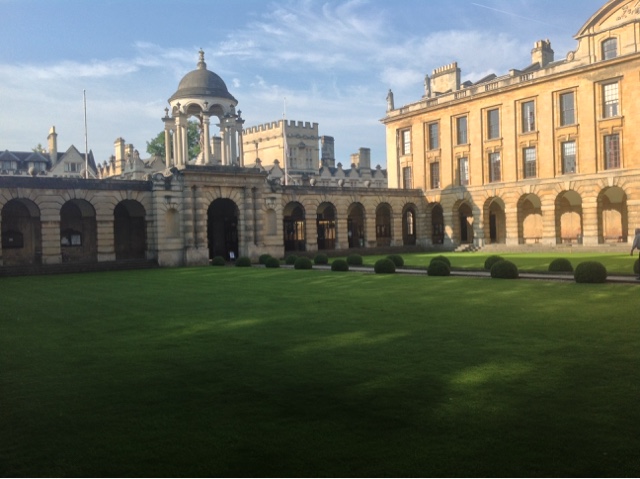
Queen's College, venue for this year's meeting 

I also enjoyed hearing Stephanie Johnston from Durham University on  'StayGreen Sorghum'. Although we don't eat much of it here, Sorghum is a dietary staple for over 500 million people, and is also important as a livestock feed and a biofuel. Drought resistance varies considerably across sorghum cultivars but StayGreen lines are the champions  as their leaves remain green even under severe drought. But no one is entirely sure why, hence Stephanie is currently investigating the potential mechanisms behind this. I must admit a vested interest in this as I worked with Stephanie on this for my undergraduate research project when I was at Durham! She started her search by performing a microarray to identify genes differentially regulated in StayGreen sorghum compared to more drought-susceptible lines. But this identified over 2,000 genes - like looking for a needle in a haystack! Fortunately, many of these genes had been characterised so Stephanie was able to identify common themes and functions. These included genes relating to the control of the stomata - tiny pores onthe underside of leaves that allow water and gas exchange. This suggested that StayGreen Sorghum may retain water by having fewer stomata or by keeping the apertures more tightly closed. It appears that both may be the case. Besides having fewer stomata, StayGreen Sorghum expresses high levels of a gene called SDIR1 ( Salt andDrought Induced Ring Finger 1) . If this is over expressed in Arabidopsis, the stomatal apertures decrease and the plants lose water more slowly. But this comes at a price - smaller pore openings restrict the amount of carbon dioxide the plants can take up for photosynthesis. As a result, StayGreen Sorghum have reduced yields under well-watered conditions. Hence, plant breeders face a challenge in improving stress-tolerance in crops without compromising harvests.
There was also an update from Emma Johnston on the 'explosive transgenic grasses' developed by Liz Dylott's lab at the University of York (see my previous post "Explosive Plant Science" http://scienceasadestiny.blogspot.co.uk/2014/04/explosive-plant-science.html). It's now thought that the genes that allow detoxification of explosives like TNT may also confer resistance to multiple herbicides. If so, these could be a new target for herbicide activity - amazingly, there hasn't been a new mode of herbicide action sincere 1980s. I can't help but feel a little jealous of Emily - this work has just been published in the prestigious journal Science. Most researchers dream of getting at least one paper into Science during their whole career and she has done it before finishing her PhD! 
Enjoying the Fellows Garden over coffee
Throwing the floor open to questions can be nerve wracking for the speaker but the feedback and suggestions given by the audience are invaluable. I lost count of the number of times audience members asked " have you ever thought of trying..." Or "why don't you look at...?" The talks also showed how ingenious researchers are when it comes to troubleshooting. Take Jenny Walton, for instance, who worried that growing her Medicago plants in soil was contaminating her trace metal analyses. So she invented her very own hydroponic system using fine mesh and a cat litter tray!   It just goes to show the importance of bringing scientists together for encouragement and inspiration - it's not just about free conference dinners!

Thanks to a burst of late-summer sunshine, we were able to congregate in the Fellow's Garden during the refreshment break and admire the flowers. Afterwards, we heard from the second year Gatsby PhD students including Alice Baille, who shares the same office as me at Sheffield. She is investigating whether it is possible to increase photosynthetic efficiency by manipulating the size of air spaces in the spongy mesophyll layer of the leaf. Carbon dioxide uptake can account for up to 50% of the limitations on photosynthetic capacity, hence engineering larger air spaces could boost productivity. One strategy may be to modify the production of pectin, a component of the cell walls which helps to 'glue' cells together. Hence, Alice is currently imaging leaves from plants with mutations in pectinmethylesterase enzymes using fluorescent antibodies to see if this affects wall formation. Will this result in bigger spaces? And - crucially - will this boost photosynthesis? No doubt we will hear more at next year's meeting!

We then jumped from leaf spaces to outer space withour before-dinner speaker, Professor Chris Lintott. Chris is Professor of Astrophysics and Citizen Science in the Department of Physics at Oxford University - although better known as presenter of 'The Sky at Night'. Despite the complete change in topic, his talk was riveting and had us in fits of laughter at times. So much so, that I'm going to make it the subject of a separate blog post- look out for it soon!

After all that science, it's time for tea! Day two coming soon!

Thursday, 3 September 2015

And my supervisor told me to get rid of them...

"Get rid of them" my supervisor told me "They're no use of you now, if there were any parasite seed that germinated they must have died by now".

'They' in question were my tobacco plants, Take Two. I had. lovingly raised from seed and, about two months ago, I had carefully transplanted them into pots of soil infested with dormant seeds of the root parasitic weed  Striga gesnerioides, the subject of my PhD project. As every plant scientist knows, the first thing you do when you start working on a new species/ mutant/ culitivar is BULK THE SEED, BULK THE SEED , BULK THE SEED! Especially if you only have one vial of it left that is fast running out...

So the idea was that, as a super susceptible host, the tobacco would act as a 'Striga-seed factory', and I would get hundreds of flowering Striga shoots emerging which would flower and hopefully give me enough seed for the rest of my PhD. So I waited and waited...

...and waited...

And nothing. It got to the stage where my supervisor decided enough was enough, we needed to move on to a different strategy. The tobacco were now taking up space and needed to be cleared out. This was at the end of June and I said I would get on to it, but , with one thing or another, I didn't quite get round to it before leaving for the Annual Meeting of the Society for Experimental Biology ( where I was attending as official science writer) in Prague. So, I put it on the 'To-Do' list for when I got back.

But when I did return....there seemed to be something poking out of the soil  surrounding one of the tobacco plants. A purplish-little dome with a bumpy surface  ...could it be?

I hardly dared to hope but nevertheless I decided to delay taking the tobacco to the tip. And the little something continued to emerge, and turned out to be a tightly closed bud supported by a delicate stem....unmistakably Striga gesnerioides. I was elated but , as the weeks went by, it seemed that this was not 'the first of many' but a fluke. No new shoots emerged and the only one that had eventually went on to flower, set seed and die. 

But then one Monday, as I checked on the plants after the weekend.... What was this??! Not one, but two, three, four....several shoots coming up now - at least one on each tobacco plant. They were finally coming!!! It actually worked!

I now think that I was watering the soil too much, causing the parasite seed to enter 'wet dormancy' (Striga gesnerioides doesn't like getting too wet). Whilst I was away, of course, they had plenty of time to dry out and wake up again!

I have a new favourite hobby now: counting my little darlings with today's  count being 36 parasite shoots in total, with 19 on a single host. My supervisor remains unimpressed though : "You need WAY more than that to get enough seed - I've seen sixty to eighty on a single plant!" Maybe so, but I'm inclined to keep hold of my tobacco for the meantime...after all, who knows what else may turn up?!


The 'Host with the Most' - Striga gesnerioides on tobacco 

Tuesday, 25 August 2015

Horsing around away from it all....

I've been feeling a bit low recently, dragged down by the endless cycle of work, work, work. By day, it is the rhizotrons and Petri dishes of the lab: by evening, wrestling with half finished articles covering the Prague conference. Even the weekends have settled into a dull monotony, not even broken by my usual volunteering work with the homeless at The Sunday Centre which, sadly, doesn't run during August. It was high time I had a break, a chance to broaden my horizons beyond the rows of plants or the computer screen before my eyes. And what better way to escape than a weekend trip to the seaside with my dear Mum? 

Neither of us had ever been to Robin Hood's Bay before; I had simply picked it out of a 'Visit Yorkshire' brochure, drawn in by phrases such as 'renown beauty spot' and 'beloved by painters and poets'. I could see why - the town was like something out of a fairy tale, a perfect smuggler's village perched improbably on the the vertiginous cliffs. The buildings were jumbled up together along a maze of crooked, winding alleys ( perfect for hide and seek!)  and apparently many of them have interconnecting attics and basements. It is said that, during the height of smuggling, an illegal barrel of tea or silk could pass from one end of the town to the other without seeing daylight! As for the sea, it was just what I needed, boundless marine blue to empty my troubled mind into, stretching away into eternity...and not a schedule in sight!
Beautiful views over Robin Hood's Bay...

We had a wonderful time catching up during long walks along the cliffs, sampling local crab and whelks, seeing families at play on the beach and watching amusedly as car drivers performed incredible feats of steering to negotiate the steep hills. I was stuck by the beauty of the local fossil specimens in the museums but sadly didn't find any myself on the beach. 

But during one of our rambles, we came arose a glade filled with 'living fossils' - a stand of horsetails. These plants are the only species that survives from the once diverse Equisetopida class, whose members dominated the Carboniferous landscape 290 million years ago, and included trees up to 30 m tall. Horsetails are described as 'primitive' as they reproduce using spores ( like ferns) unlike 'modern' land plants which use seeds.  They also have greatly reduced leaves, called 'microphylls', that each have a single, unbranched vein instead of the intricate networks of veins we admire on most leaves today. You can certainly imagine them as being the sort of thing a dinosaur would munch on...and yet these primitive plants are apparently generating renewed interest among scientists. Horsetail extracts are said to act against all manner of illnesses, including diabetes, osteoporosis and bladder problems. There is even evidence that they may stop the proliferation of cancer cells*. For myself, I simply enjoyed appreciating the beauty of their minimalist architecture and the  pleasure of coming across them unexpectedly. It just proves that with plants, you never know what is round the corner!
The glade of horsetails - a blast from the past

It really was a timely break for me and has hopefully left me refreshed enough to last through to the end of the Academic year. It was also quite nice to have a 'digital detox' although it felt surreal to stay in B and B with free WiFi and to not be able to take advantage of it! Suffice to say, I am not looking forward to seeing the state of my inbox on my return...but, the show must go on, so back to work we go!

* For more information about the uses of horsetail extracts, see  http://www.naturalalternativeremedy.com/sixteen-horsetail-benefits/ For the study investigating horsetail extract effects on cancer cells, see the paper "Antioxidative and Antiproliferative Activities of Different Horsetail (Equisetum arvense L.) Extracts" (Journal of Medicinal Food)
Robin Hood's Bay by morning...worth getting up early for that magical light!

Sunday, 16 August 2015

Seeing is believing......

One of the objectives for my PhD ( and hopefully a thesis chapter...?) is to completely characterise the  process by which Striga gesnerioides gains entry into the roots of Arabidopsis thaliana. On the outside,  I can first tell if one of the tiny Striga seeds has successfully infected the host root when it begins to swell into a tubercule. In a really good infection, the root can be strung with tiny bobbles, like a chain of knobbly Christmas baubles. But this is a comparatively late stage of the infection process. To understand how the parasite may be suppressing host defences, I need to know at what point it begins to break through the outer root layer, the epidermis, and starts squeezing through the cortical cells towards the central vascular bundle. The key moment is when the parasite connects to the hosts xylem vessels - at which point it can freely withdraw water and nutrients to fuel it's own growth. All of which is very difficult to tell from the outside!

Hence, I have been busy with my scalpel - hacking off sections of infected root to take samples of tissue. I have then been putting these through a long and convoluted protocol to embed these in a material called Technovit - the whole process takes about two weeks and makes the recipe for a wedding cake seem easy by comparison! But this is necessary because Technovit is strong enough to be able to take ultra thin ( 5-10 micro etre ) slices off the sample using the microtome. I have a 'love- hate' relationship with this machine....For my first attempts, I would spend hours and hours on it and yet my sections would look like a jumbled mess under the microscope. Just lately, I have been having more success, learning to bring the blade down in a smooth, rapid motion ( I think of it like a guillotine - if it was my head on the block, how would I like the blade to come down?!). After staining my latest batch of samples, it was exciting to see how they turned out!

The host Arabidopsis root is on the left and the parasite tubercule is on the right, before I reach the point of contact. 

These sections were taken 14 days after I applied the Striga seed to the roots. When I take sections, I slice along a length of root latitudinally. So as I go along the root, all I can see at first is the host root until I reach a tubercule. As the tubercule swells up around the point of entry, initially it doesn't seem to be attached to the root. But as I continue taking sections, the tubercule seems to get closer and closer until I reach the point of contact. At this stage, I can begin to see how much the parasite has disrupted the host root and how extensive its connections to the vascular bundle are.

The point of entry - Striga gesnerioides forces its way in...

Even with these sections however, it can be difficult to tell what is going on ( but you should have seen my first attempts!). Consequently, I am now taking sections from some very exciting Arabidopsis mutants expressing an enzyme called GUS. This means that when I treat the root sections with a certain dye, they will turn green. Because only the host Arabidopsis only expresses GUS and not the parasite, only the host tissue will change colour. So it should be easier to work out which cells belong to Striga and which belong to Arabidopsis. That's the theory anyway - I'll let you know how I get on!

A big jumbled mess....an Arabidopsis root infected with Striga gesnerioides

Can you see the difference? The infected root sample on the right was taken from a GUS-expressing Arabidopsis host, whilst the one on the left comes from a control 'wild-type' host.

Monday, 10 August 2015

Biotech YES!!! Let the Challenge commence...

My life seems hectic enough with my full-time research, voluntary commitments, blogging and science writing... So is it really a good idea for me to enter the prestigious BiotechYES Challenge as part of a team from the University of Sheffield? But I just cannot resist such a good opportunity! The challenge of this competition is to come up with an idea for a novel biotechnologically based product or service and draw up a business plan to pitch to a panel of industry experts. In the process, teams develop their financial awareness, meet major biotech industry players and receive expert training from business mentors. Having out my name down, it was now up to me to represent my team at the Briefing Session held at the University of Nottingham.


I had hoped that this competition would be a bit of 'fun' with plenty of networking and career-enhancing workshops thrown in. But on entering the lecture theatre at Nottingham University's Business School, I suddenly realised just how serious this was going it be! The room was packed to the very back row with delegates from over a hundred teams, from across the whole UK. I was lucky to only have had to travel from Sheffield! There was a steely edge amongst the chatter and it was clear that these people hadn't come here for a holiday. Fortunately I spotted Emily Seward, who is also in the Gatsby Plants Network, so had a friend to sit next to. It's funny how these plant scientists crop up everywhere!
The delegates arrive at Nottingham University Business School, Jubilee Campus ( Photograph courtesy of Haydn Green Institute for Innovation and Entrepreneurship). 

Simon Mosey, a Professor in Entrepreneurship and Innovation at Nottingham University, welcomed us by explaining that this year was a very special one for BioTechYES. This would be the 20 th year of the competition, which has grown so rapidly from its origins that soon over 5,000 students will have progressed through it. As he described the prestigious 'BiotechYES Alumni Network' I began to feel woefully inadequate of reaching the high standards of the competition. But Simon was keen to dispel some common myths about successful business people. "Entrepreneurs are not special people who can see the future or who have different chromosomes to the rest of us" he said. "Rather, they just have the courage to try the things you may think of but be too scared to do". Instead of simply waking up one day with a brilliant idea, entrepreneurs typically have to experiment with hundreds of different ideas and get used to most of them failing. Furthermore, "entrepreneurs don't do it all themselves". Although one person may be the figurehead of a product or business ( such as Steve Jobs was with Apple ), behind them will be a highly talented and motivated team. Hence, the ability to work with very different people is critical. According to a recent survey of company CEOs, the key piece of advice that they would give those hoping to launch their own start up is to use every opportunity to build your network.

The stage was then handed to Dr Simon Cutler, a Senior Innovation and Skills Programme Manager at the Biotechnology and Biological Sciences Research Council (BBSRC). He explained the value of taking time away from our normal research to enter the competition. Besides the obvious transferable skills we would develop - such as teamwork and communication - we would also acquire some less obvious ones, including the ability to handle conflict and work through sleep deprivation! ( WHAT have I let myself I for?!) We would also have the chance to work with major bioscience businesses and forge valuable contacts for the future. "Hopefully we will all be winners" he said. "You will develop an enterprise mindset and have the opportunity to think about what you want to do for the rest of your life".
The crowded auditorium
( Photograph courtesy of Haydn Green Institute for Innovation and Entrepreneurship). 

Dr Nessa Carey, from PraxisUnico ( a research innovation network )  rose to introduce us to the role of Technology Transfer Officers and how they help researchers to increase the impact of their work. She began by encouraging us to 'play with' our career choices until we find the role we feel especially called to. "Your career is the one area that you can experiment with and you will always gain" she said. Her own story is a singular example of this. Having originally applied to study veterinary medicine she quickly realised that "I was hopeless at it - I can't think in 3D and I'm allergic to hay, fur and feathers". After a stint as a forensic scientist for the Metropolitan Police, she decided to do a scientific degree then found herself back at the veterinary faculty to do a PhD! Eventually she came to work for the pharmaceutical giant, Pfizer, having been drawn to a role where she could make a difference beyond the laboratory. "I now work at the interface between the Academic and Industrial worlds, working out how to make research have an impact" she said. 

And yet Nessa insists that she has never had any formal training for what she does now. "I've never been a Technical Transfer Officer but I've done all the bits needed to become one" she said. "The great news is that you can pick up all the skills for a job without doing the job itself - all while being a really average scientist!" This was wonderful for me to hear since I have long realised that I am not a member of the tier of 'brilliant scientists' on course to become the Professors of the future. Indeed, Nessa assured us that "there are very few great scientists - although there are lots who think they are" , yet it was still possible for us to dream of a career with variety, travel and impactful work. Including that of being a technical transfer officer ( TTO). Nessa explained that, rather than being the "battle axes or walls" that block exciting research from getting out into the world, TTOs are more like navigation aids to help academics through the maze of patents, legal requirements, etc surrounding their work. For science to be delivered properly to society, it needs to have someone with a firm grounding in the 'real world'. She told a humorous story about an Academic who rang her on a Thursday with a 'brilliant idea'. When she asked when he was thinking of disclosing it, he answered "Oh, on Monday". Cue a mad dash to Cambridge to find an attorney at the last minute so the patent could be filed before the office closed at 5 pm on Friday! Academics may be brilliant at what they do, but they haven't always got their finger on the pulse of the practicalities of industrialising research...
Delegates mingle over the lunch break
( Photograph courtesy of Haydn Green Institute for Innovation and Entrepreneurship). 

We were then introduced to the 2014 winners of BiotechYES. They had certainly had a glamorous time since last year's competition - £2,500 prize money, a whirlwind of gala dinners and a trip to Houston, USA to take part in the RISE Business Plan competition. But they had also clearly out in a lot of time and effort into their Biotech entry. Their science was convincing, their PowerPoint slides highly professional and even for this relatively informal occasion, their delivery was slick and polished. They had even thought to bring wine as a 'thank you' to the Biotech organisers! We were all keen to hear their advice to us, the next batch of entrants. Firstly - be comfortable with generating bad ideas. It had taken a giant pool of brainstorming to find their winning idea! Secondly - do as much advance preparation as possible as time at the workshops is extremely limited and highly pressured. Third - the science behind the product is not as important as the market potential - you need a convincing story to draw your investors in. In their case, their winning product was a naturally decaffinated coffee bean. So they began their pitch by inviting the judging panel to sample some of their delicious new blend before launching into their spiel: "It looks like coffee....it smells like coffee...and as you can see, it tastes like coffee....but there's one thing missing!" Hence, the art of 'storytelling' can be added to that list of transferable skills!

By this time we were ready for lunch. I had been so inspired by Nessa's talk that I acted on the advice to network, network, network and caught up with her for a chat and to exchange business cards. Meanwhile, the delegates took advantage of the sunshine to relax outside, reviving themselves on the fountain of cupcakes...
Delegates during the lunch break
( Photograph courtesy of Haydn Green Institute for Innovation and Entrepreneurship). 

In the afternoon session, Dr David Park from Newzpark Ltd gave us his perspective as someone who had 'been there and done it' when it came to starting his own business. "If I had my time again, I would tell myself to focus more and not try to take over the world!" He said. Indeed his first business, in the area of "Integrated Data Systems and Processing" had a rather haphazard start, involving writing a hurried business plan on a train to an interview and asking his wife at the last minute "How would you like to live in New Zealand?" Subsequently, he set up the Geospatial Research Station, a consultancy company based in Christchurch. Life could certainly be hectic at times, dodging volcanoes and emperor penguins besides overcoming the usual financial hurdles of establishing a business. "It will be stressful at times and you will be sick to the stomach" he said "but starting a business should be fun and you have to take a moment to enjoy the good times". Although the GRS didn't survive the recession, David was adamant  "I'd absolutely do it again". He encouraged all of us to have the courage to follow our entrepreneurial dreams : "Don't be afraid to give it a go - you won't be left with a pile of broken experiences" he said.


He also had some useful advice for the BiotechYES competition. When pitching for cash, it is vital to understand the drivers and oriorities of your shareholders. Again, he emphasised the importance of crafting a compelling story to attract investment. "Become the best storyteller ever" he said. "When pitching, practice and refine the start and the end the most - if they are perfect, the rest will fit." Meanwhile, don't underestimate how long things take and how much they cost: "Multiple all estimates of time and cost by pi" he advised. And finally, "Take some time to step back from the technical work and give yourself space to ask 'Why am I doing this?'" David advised. It can be all too easy to loose a sense of perspective when you have a business to run!

Now it was time for us to do some work during the 'Ideas Generation Challenge'. We were introduced to IngenuityOnline, an online portal where different users can sign up to 'challenges' to suggest solutions to a particular problem. First, we had to vote on a topical issue to work on that afternoon, with ageing and increasing longevity coming out on top. Then we had to define the problem, breaking it down into things we associated with it. The ideas here covered the scope from 'going wrinkly' to 'reduced mobility' and 'the cost of care'. As everyone's ideas were pooled together, a complex picture began to form of the social, economic and physical aspects of the 'ageing problem'. Now we had to throw up solutions and were encouraged to be as whacky and adventurous as we liked, although perhaps some people took this a bit too far, using the opportunity to express their dislike of certain political parties ... The online tools allowed us to play about with the ideas suggested by others, merging things together and calling up visual representations. So, for example, could we somehow think of a solution that involved both 'brain training games' and 'fortified green tea extract'? 
Simon Cutler of the BBSRC explains how BiotechYES has evolved over 20 years
( Photograph courtesy of Haydn Green Institute for Innovation and Entrepreneurship). 

It was a fascinating experience of brainstorming in real time but also incredibly complicated to master - in future, I may stick to pen and paper! But it was time to head to the shuttle coaches back to Nottingham Station. Armed with hundreds of new ideas, a Biotech goody bag and a new sense of resolve, I had a team meeting to organise back at Sheffield! The challenge has been set - now we have to get ready for it!

Special thanks for the BiotechYES organisers, especially Tracey-Hassal Jones for organising the event.


Sunday, 2 August 2015

And there was evening and there was morning...

I thought life had been busy before the Prague conference.... Now I have discovered another level! During the main part of the day, it is a rush to fit in all my experimental work (which has picked up again alarmingly quickly): booking slots to use the microtome for making sections of harvested root tissues, preparing stock solutions, scoring plants for infection,preconditioning parasite seed, etc. Then, as evening comes on, I head to the library to carry on wading through my notes, interviews and email correspondences from the conference. Slowly, the articles I have been commissioned to write are taking shape but it is a convoluted progress due to the number of different researchers whose work I am featuring! So probably not the best time to take on yet more work by offering to write a few peices for the "Student Guide to Sheffield Univeristy 2015"... When will I learn to say "No"?

Staying so late at work makes me really appreciate my new location close to the Department. I have really settled into my new flat now, and can't now imagine going back to Univeristy Halls - I have finally made the break! My parsley plants have happily colonised the windowsill and I have even started to use them to accompany my fish dinners. I can begin to understand the fuss behind organic food - the taste was so superior to the supermarket varieties - could it be due to the lack of pesticides and chemical inputs?

It has also been a busy week as I have, as they say so often at The Works, been "clearing everything out to make way for fabulous new stock"! I have set up an ambitious experimental plan to test four new mutant Arabidopsis lines, each defective in a certain defence signalling pathway, to see if this makes them more ( or less?) susceptible to infection by the root parasite Striga gesnerioides. But I have found that it is much more fun to plan a slew of experiments than to clear up everything afterwards.... However, I only have so much space in my cabinets so I have had to devote some time to bagging up my poor finished plants and chucking them out. I'm not the most popular person in the annexe when I take over all the sink space to wash hundreds of rhizotrons at a time! 


At least when I am on my way to work, trying to clear my head through the fug of morning tiredness, this wonderful array of wildflowers gives me a lift. It is only a narrow strip in an otherwise ecologically barren desert of lawn but it fairly thrums with bees and butterflies. Judging by the number of posts of Facebook, it has been giving plenty of other people a boost of pleasure as well! I wish I knew who the inspired landscaper was so I could thank them. One of the things I really like about Sheffield is that these little nuggets of greenery are often left to the benefit of wildlife, rather than cleared up to make everything neat and tidy. And it really does make a difference, both to people and animals. I even heard owls on my way home last night...

I hope you are having a more relaxing weekend than me! Right, better get back to these articles....

Saturday, 25 July 2015

Time to consider the world beneath our feet...


Although I am a plant scientist, I rarely get to work with proper soil (my Arabidopsis seedlings are all grown on an artificial medium called vermiculite which looks a bit like muesli). But given that soil is so critical for growing crops - and thus underpins the base of all our food chains - it is something we should all take make seriously. To address my general ignorance, last week I went along to 'Building UK Soils - Political and Practical Opportunities', a seminar organised by the Grantham Centre for Sustainable Futures.
One of the Soil Association's roles is certifying farms that meet organic status, such as this one, West Town Organic ( photo - The Soil Association) 
Both of the invited speakers worked for the Soil Association, a charity formed in 1946 with the aim of 'demonstrating and promoting the link between healthy soils, healthy plants and healthy people'. You may have come across their logo during your weekly shop as they operate the British Organic certification scheme. Head of Horticulture Ben Raskin immediately debunked the popular misconception that soil is dull, inert and uninteresting by sharing some impressive statistics. For instance, it is thought that there are more organisms in a teaspoon of soil than there are people on the planet - including Rotifers, tardigrades, mites, nematodes, Protozoa and around 4,000 million bacteria. So it's not just about worms and spiders! With all this diversity, it is not surprising that soils can vary considerably between regions, especially as they are also shaped by environmental factors such as pH, climate and water availability. All this, of course, has a direct impact on the crops growing on the surface. For example, the availability of essential nutrients for plant growth is highly sensitive to the pH of the soil. Over recent years however, it seems that farmers are attaching less and less importance to basic 'soil husbandry'  and are being increasingly 'disconnected' from the landscape. As agriculture becomes more industrialised and mechanised, farmers spend very little time actually handling the earth their livelihoods depend on. "Everything we do has an impact and that has to be considered when building a long term system" said Ben. But this is rarely considered - for instance, when farmers spray their ploughs with fungicides, this ultimately kills many of the beneficial fungi strains within the soil. According to Ben, these problems are aggravated by the trend towards short tenancy arrangements - a far cry from the days when farms were handed down between the generations. As a result, farmers are focused on "getting their crops in the ground, harvesting them and then getting out" - with little thought for the state they leave the soil in for the next occupant. 
Could ancient grazing methods save our soil for the future? ( Photo - The Soil Association) 

But there are some very creative ideas out there to help reverse this damage, including agroforestry, where introducing trees onto farmland can protect the soil and improve fertility. Another strategy, particularly for dairy farms, is 'mob grazing'. In this practice, rather than letting farm animals wander freely over the field, the animals are kept in fenced off blocks to completely graze one area before being moved to another. According to Ben "This is more similar to when herbivores roamed the land in ancient times, grazing one area before moving on and not coming back". However, more work is needed to translate these ideas into common practice. "University researchers are doing wonderful projects but they don't get anywhere - we need farmers and researchers to work together" Ben said. As part of a three year programme, The Soil Association, in partnership with the Duchy Future Farming Project, is funding a range of on-farm projects to investigate the potential benefits of altered practices. Meanwhile, 'Innovative Farming Clubs' are encouraging the agricultural community to communicate more about soil issues.  "If people are sitting in their own silos, doing their own thing, they can miss what's going on" Ben said, before giving the example of a farmer who was inspired by a football manager to install vertical drains on his farm. Hopefully, with more of this 'joined- up thinking', these innovations can begin to be disseminated on a wider scale.
Ben Raskin and Louise Payton from the Soil Association
It's one thing to get farmers excited about soil but what about the Government? Enter Louise Payton, Policy Officer at The Soil Association. She began by introducing the rather frightening situation regarding global soils: a quarter of all soil in the world is severely degraded with 10 million hectares ( an area the size of England and Wales combined) being abandoned every year. According to some estimates, we may only have 60 years of viable topsoil left to grow crops. Perhaps most dramatic was her slide showing a satellite photograph of the UK taken after the terrible floods of 2013-14. The waters hugging the coastline had literally been stained brown by the soil which had been washed off from inland. It seems that Governments are slowly waking up to the soil crisis, with 2015 being designated the 'International Year of Soil'. But unfortunately, this hasn't really amounted to much so far. In the UK, the  Government's soil policies are quite vague, along the lines that farmers should maintain soil organic matter and take steps to minimise soil erosion - particularly by planting cover crops instead of leaving the earth bare. But as Louise said, "The problem with these regulations is that when you look at the details, they don't really mean anything". For instance, maize stubble could be interpreted as a 'cover crop' even though this is pretty useless at preventing erosion. In addition, there is a convenient loophole which allows famers to avoid taking the effort to protect their soils 'if it would affect their business'. The EU has Directives for air, habitats and water - so why not soil?! As Louise explained, air, water and wildlife are seen as entities for the public good that are not owned by anybody. Land in the other hand, is most definitely owned by somebody and so governments are hesitant to impose legislation, feeling it is outside their bounds. The Soil Association is campaigning to move soils further up the government agenda although success has been limited so far: the last time they sent a letter to the Secretary of State, apparently the reply went along the lines of "Sorry, we're too busy right now, and soils aren't that interesting!" 
Living soil - so much more than dirt and vital for our future! Photo courtesy of 
 Ben Llewellyn

But perhaps things are about to change. Recently, The UK Climate Change Committee released a report describing UK soils as having 'red status', declaring that "the agricultural a community has been blind to what has been happening'. Meanwhile the Soil Association have focused their efforts on getting the Government to agree to a target of improving soil organic matter (SOM) across the country by 20% by the year 2020. This would have multiple benefits for soil health, beyond improving fertility and the microbial communities of the soil. For one thing, SOM helps to capture carbon, thus mitigating against climate change. In addition, "it acts a but like a sponge" - capturing water during drought and draining it away in times of flood. Another campaign is for greater research into how pesticides affect soil health. Louise presented the results of a study which found that, over the course of one year, 22 active chemicals were used on a single field of oilseed rape alone. The effects that these chemical cocktails have on soil communities is virtually unknown. Hence, as a first step, the Soil Association are commissioning studies on the most common insecticides: glyphosphate sand neonicotinoids. If I wasn't already studying parasitic weeds, I might be tempted to retrain as a soil scientist! But in the meantime, I will certainly have a greater respect for soils and will keep my eye out for campaigns to have their role recognised by our politicians also.