The newly refurbished Sheffield Cathedral thrilled with anticipation as the packed crowd waited for the arrival of a speaker with a pioneering message about sustainability. On arrival however, it was clear that Ron Finley, dressed as a strawberry, was not about to deliver a moral, guilt- inducing lecture. Instead, the evening was an inspiring account of how one person can truly make a difference to their community, and ultimately the world.
A former fashion designer, Finley became exasperated at the impoverished state of the communities around his home in South Central, USA. Not that there was a lack of food - instead, streets of houses were shoehorned by fast- food outlets, supermarkets and diners. Nevertheless, there was a distinct lack of nutritious foodstuffs - fresh fruit and vegetables. To Finley's mind, this food imbalance was the key underlying cause of the rise in chronic 'Western' diseases such as obesity, diabetes and heart disease. He saw that he and his neighbours lived in a 'food prison' , allowing themselves to depend entirely on others for food. But how to escape?
Besides fast food eateries, South Central also has a lot of vacant lots, areas of wasteland neglected by local authorities. On one such strip outside his house, Finley daringly planted tomatoes, carrots, mustard greens, sunflowers and more, turning the street into a garden. Despite the beauty and bounty this provided, a complaint from a neighbour led to Finley being arrested. This prompted a successful campaign which changed the local law, allowing citizens to grow produce on their parkways.
Finley was evangelical in his message that this was more than about growing a few vegetables to enhance his own meals. Instead, he deliberately planned the street garden so that neighbours would be able to help themselves as they passed. His vision is for neighbourhoods to feed themselves, growing and sharing vegetables on community land. To him, this is the ultimate act of defiance - fighting back against the reliance on mass- produced, processed food.
Since then, Finley and his 'gangsta gardeners' have worked with various communities to set up new street gardens. It is clear that these have had effects beyond improving nutrition, especially in helping children to engage with nature. 'Gardens can teach so many lessons' Finley said 'everything in life happens in a garden'. Time and again, he has observed young people become 'seduced by the soil' and his gardens have proved therapeutic for those suffering from substance abuse, mental and physical conditions and the pressures of gang warfare. Once children start growing healthier foods, they also become much more enthusiastic about incorporating them into their diets.
Finley distinguishes himself from guerrilla gardeners ( those that plant seeds / gardens at midnight then vanish before morning), instead styling himself as a 'gangsta gardener'. The key difference, he says, is stewardship. He only works with communities that are prepared to take ownership of their garden and maintain it. During the question period that followed, a representative of a Sheffield Council also made the point that it was no good for the council to 'do things at people' but that sustainable community initiatives had to be undertaken by the people themselves. The overriding message appeared to be that councils are more supportive than the public may think and are prepared to back ideas that people are committed to maintain themselves. In fact, a new 'urban garden' is being planned for Sheffield City centre, called 'the Love Square'. Fingers crossed it will have the same effects as Finley's Garden! ( see http://lovesquare.group.shef.ac.uk )
According to Finley, ' they are telling us a lie, that we need them to feed us'. As a plant scientist, I found this a little hard to stomach, having been brought up to believe that sustainable, mass agricultural systems are the most efficient way to feed the global population. However, I believe that the world would be a healthier and happier place if most people did grow their own food. Perhaps a community in the UK could sustain itself on produce grown and reared by its members? Nevertheless, there is also a compelling argument that the 'delegation of labour' frees other people to become inventors, medical researchers, technicians, artists, poets... Perhaps a mix of both approaches is best?
So what do people think? Is mass produced agriculture a glory of the modern world or leading many to an early grave? Comments below please!
Click hear for a Reader's Digest interview with Ron Finley and a video of his 'Gospel Message' http://www.rd.com/culture/ron-finley-gangsta-gardener/#.

Wednesday, 24 September 2014

Thursday, 18 September 2014
Genes for Jeans day tomorrow!
On Friday 19 th September, many people will be donning their denims at work or school to raise awareness and funds for research into genetic disorders. Some, such as cystic fibrosis, are well known, others - including the painful skin condition Icthyosis - less so, but all limit the ability of those affected to enjoy lives as full as their contemporaries. It can be easy to forget these conditions in the face of the global empires of cancer, HIV, malaria, etc, but as we gain increasing knowledge of the mechanisms behind genetic diseases, there is hope that one day there could be real treatment against these.
Jeans for Genes originated in the 1990s, as part of a family's efforts to raise funds for The Chronic Granulomatous Disorder Society. Two brothers within the family were affected by this condition which hinders the ability of the body's immune cells to kill pathogens. The idea has since grown into a national event to raise money for Genetic Disorders UK, which supports families affected by genetic conditions. This year, Jeans for Genes has worked with Edinburgh College of Art to produce a series of limited edition T-Shirts. To me, the design is a perfect combination of promoting my scientific interests whilst supporting a valuable cause. It is also brilliant to use science to make a fashion statement! Or should that be the other way around?
With so many pressures facing our world - food security, health, energy generation- scientists often have to stretch their creative powers to garner enough funds to persue their work. It is difficult when there are so many promising avenues of research for funding bodies to decide between them.
But the public can play their part so I shall wear my T Shirt with pride.
If it's too late this year for you to organise an event with your colleagues, why not resolve now to wear your genes on Jeans for Genes Day 2015?
For more information see http://www.jeansforgenesday.org
Jeans for Genes originated in the 1990s, as part of a family's efforts to raise funds for The Chronic Granulomatous Disorder Society. Two brothers within the family were affected by this condition which hinders the ability of the body's immune cells to kill pathogens. The idea has since grown into a national event to raise money for Genetic Disorders UK, which supports families affected by genetic conditions. This year, Jeans for Genes has worked with Edinburgh College of Art to produce a series of limited edition T-Shirts. To me, the design is a perfect combination of promoting my scientific interests whilst supporting a valuable cause. It is also brilliant to use science to make a fashion statement! Or should that be the other way around?
With so many pressures facing our world - food security, health, energy generation- scientists often have to stretch their creative powers to garner enough funds to persue their work. It is difficult when there are so many promising avenues of research for funding bodies to decide between them.
But the public can play their part so I shall wear my T Shirt with pride.
 |
| Jeans for Genes Day T-Shirt Design 2014 |
If it's too late this year for you to organise an event with your colleagues, why not resolve now to wear your genes on Jeans for Genes Day 2015?
For more information see http://www.jeansforgenesday.org
Friday, 5 September 2014
Another year, another name badge! The Annual Gatsby Plants Network Meeting 4-5 th September 2014
Is it that time already? It hardly seems a week since the last Gatsby Plants Annual network meeting. Still, I'm of complaining as it is a lovely opportunity to catch up with friends and to stimulate ideas for my own research experiments.
This year the venue is Somerville College, Oxford. Although the grounds are lovely and bursting with an abundance of floral species, I am slightly disappointed that we are housed in a modern university block...I had got used to the quirky college rooms with their nooks, crannies and occasionally pianos. Nevertheless, it doesn't detract for the science, which- as usual- is top notch. Thursday afternoon is mostly dedicated to talks from Gatsby funded PhD students encompassing everything from micro compartmentalisation of the enzyme aldolase, chromosome recombination in Arabidopsis and resistance against the pathogenic oomycete Albugo laibachi. I always struggle to get my head around some of the development talks, particularly how polarity fields and hormone gradients can promote the growth of specific shapes. Some ingenious comparative models were used in the talks to explain such concepts, including pizza dough and lolly pops. Visual imagery always helps! I was also intrigued by an experimental method called FRET to determine if two proteins interact in a cell. By altering the encoding gene, it is possible to engineer proteins to have a fluorescent 'tag' which absorbs a certain light wavelength and re- emits some of the energy as fluorescent light. Some of the energy, however, can be transferred to surrounding molecules (known as Fluorescence Resonance Energy Transfer, FRET). So too see if two proteins interact, one can tag each with different fluorescent markers that are excited by different light wavelengths. When the first fluorescent marker ( say a green marker) absorbs light energy, it can transfer energy by FRET to the second marker ( eg.a red marker), but ONLY if they are very close together ( within 10 nm). So if the proteins are far apart, when the green tag is illuminated, it can only re- emit green light. If the proteins ( and hence the markers) are close together however, the green marker can pass on energy by FRET to the red marker, and red light will be seen. I am constantly amazed at the methods designed by biologists to answer questions!

The Delightful Grounds of Somerville College, Oxford
After quite a marathon of talks, with a short break for coffee, the evening gave way to a discussion on the future of publishing in plant science, chaired by a panel of journal editors. Professor Mike Blatt, editor of Plant Physiology, made the point that many people often assume that scientific journal editors are 'failed scientists' who couldn't handle the pressures of a research- based career. On the contrary, most journal editors are very much 'active' scientists, who manage to fit in editing and reviewing with their own research agendas. There was much debate on how the move towards 'open access' publishing can be financially sustained. Although there is great pressure for publicly-funded research to be made freely available, most journals receive most of their revenue from subscriptions. Without this income, how can we ensure that these remain high quality and rigorously reviewed publishing platforms? Eventually, the talk was pulled to a close and we tripped onto the lane for the drinks reception. The formal meal was very enjoyable, the highlight for me being 'Japanese breaded baby carrots' although the menu didn't specify what exactly made the dish 'Japanese' - were they Panko breadcrumbs? Did it refer to the way the carrots had been exquisitely julienned? Were the carrots themselves from Japan?

Guinea Fowl with those "Japanese" carrots...
The next morning kicked off with an open platform to discuss strategies to inspire plant science teaching in schools. I can remember from my GCSEs that my teachers were almost apologetic when we reached plant topics, with an air of 'I'm sorry but we HAVE to do this because it's on the exam...'. To combat this, Science And Plants in Schools (SAPS) have produced a stunning suite of freely available teaching resources ( including lesson plans, animations, work sheets) - the problem is now getting the message out there so that teachers actually use them!

Somerville College, Oxford
After more talks from the PhD students, the meeting closed with a presentation by Professor Cathie Martin of The John Innes Centre, to describe the potential of nutrient enhanced food to combat chronic diseases. Her work has mainly focused on the purple tomato; a GM crop with a introduced pigment gene from Antirrhinum ( snapdragon). This increases the production of anthocyanins, said to protect against a range of chronic diseases. To test this, the tomatoes were fed to mice genetically engineered to be deficient in the tumour suppressor p53. This dramatically reduces the lifespans of the mice to an average of 140 days. Supplementing the mice's diet with red tomatoes had little effect, however introducing purple tomatoes caused them to live 30% longer, up to 180 days. The tomatoes were also tested in atherosclerosis - prone mice, where it was found that, as the proportion of purple tomatoes in their diet increased, the area of fatty plaque on the arteries reduced. European regulations mean that these 'wonder fruits ' are currently only available as a juice in the United States. Professor Martin's group are currently seeking to develop tomatoes enriched in resveratol ( a compound found in red grapes claimed to promote longevity and weight loss) and phytoestrogens ( which could benefit women approaching the menopause). Having an abundance of bio enriched foods sounds wonderful, however Professor Martin pointed out one can't rely on these foods alone for good health. The plaque reducing properties of purple tomatoes for instance, would be severely negated by pairing them with melted cheese on a pizza! It was interesting though, that the plums were the first fruit to run out over the leaving lunch....
How the years roll by... At least it means I can count on the next meeting being here before I know it! So long for now!
Tuesday, 19 August 2014
Precious Peatlands...
I've been spending some time recently exploring the Hope Valley in The Peak District. I wasn't quite prepared for how captivating the scenery would be - everyone has heard of the sumptuous beauty of the Lake District, yet the Peaks remain relatively unheard of, although I think they are just as stunning, with a more rugged and rural quality.

I was also unaware of the dramatic colour display that this time of year brings - the gentle eruption of the purple carpet of Heather. Besides it's visual splendour, however this landscape has a critical ecological importance, as it contains a large proportion of the Britain's Peat Bogland. Peat is an ancient substance that forms from dead plant matter under conditions where natural decomposition by bacteria is prevented. In the case of the Pennies, this was due to the glaciers of the ice age covering the terrain. Because the plant matter does not break down fully, peat has a high carbon value. So much so, that although peatlands cover only 3 % of the world's surface, they store twice as much carbon as arboreal forests. And yet, these precious reserves are under threat, suffering greatly from erosion. Although some of is is caused by severe rainfall ( which is though to be increasing due to climate change), much damage is also caused by enthusiastic walkers - so next time you see a polite notice asking you to keep to the footpath, please do heed it! Fortunately, the National Trust are well aware of this issue and are prepared to spend a considerable amount of time and money to address it. Of one of my rambles, I even met a ranger who works professionally to restore peat moorland in this area. Phase one involves planting 'stabilising vegetation' to hold the peat lands in place and prevent further erosion. Following this, gullies that channel rainwater are blocked up to limit the amount washed away by rainfall. The third phase involves more planting - plugs of typical bog species such as Eriophorum vaginatum at a density of 4,000 per hectare. Finally, in the 'Hydro- Seeding' Phase, a helicopter is deployed to drop seeds of species such as Caluna vulgaris, also called common heather. It seems almost perverse that so much manual effort and technology must be used to restore a completely natural landscape but, as much of the damage has been called by ourselves, I think we should feel some obligation. It also highlights the dedication of these organisations - restoring peat can't be as glamorous as saving rhinos but still, they quietly get on with the job. It is certainly worthwhile for views such as these and I hope it will compel others to support these charities.

It is also important because peatlands are the foundation for a unique ecological web. I have seen so much evidence of wildlife on my travels here - kestrels, rabbits, hares, moles... And so any wildflowers that I am constantly embarrassed by my ignorance of native flowers. That's one thing I am still working on!
For more information on Peat Land restoration in The Pennines, please see http://www.nationalparks.gov.uk/lookingafter/climate-change/moor-restoration-in-peak-district
Meanwhile, the best way for you to experience this natural palette of stunning colour is to come here yourself.
The Heather on Win Hill
I was also unaware of the dramatic colour display that this time of year brings - the gentle eruption of the purple carpet of Heather. Besides it's visual splendour, however this landscape has a critical ecological importance, as it contains a large proportion of the Britain's Peat Bogland. Peat is an ancient substance that forms from dead plant matter under conditions where natural decomposition by bacteria is prevented. In the case of the Pennies, this was due to the glaciers of the ice age covering the terrain. Because the plant matter does not break down fully, peat has a high carbon value. So much so, that although peatlands cover only 3 % of the world's surface, they store twice as much carbon as arboreal forests. And yet, these precious reserves are under threat, suffering greatly from erosion. Although some of is is caused by severe rainfall ( which is though to be increasing due to climate change), much damage is also caused by enthusiastic walkers - so next time you see a polite notice asking you to keep to the footpath, please do heed it! Fortunately, the National Trust are well aware of this issue and are prepared to spend a considerable amount of time and money to address it. Of one of my rambles, I even met a ranger who works professionally to restore peat moorland in this area. Phase one involves planting 'stabilising vegetation' to hold the peat lands in place and prevent further erosion. Following this, gullies that channel rainwater are blocked up to limit the amount washed away by rainfall. The third phase involves more planting - plugs of typical bog species such as Eriophorum vaginatum at a density of 4,000 per hectare. Finally, in the 'Hydro- Seeding' Phase, a helicopter is deployed to drop seeds of species such as Caluna vulgaris, also called common heather. It seems almost perverse that so much manual effort and technology must be used to restore a completely natural landscape but, as much of the damage has been called by ourselves, I think we should feel some obligation. It also highlights the dedication of these organisations - restoring peat can't be as glamorous as saving rhinos but still, they quietly get on with the job. It is certainly worthwhile for views such as these and I hope it will compel others to support these charities.
It is also important because peatlands are the foundation for a unique ecological web. I have seen so much evidence of wildlife on my travels here - kestrels, rabbits, hares, moles... And so any wildflowers that I am constantly embarrassed by my ignorance of native flowers. That's one thing I am still working on!
For more information on Peat Land restoration in The Pennines, please see http://www.nationalparks.gov.uk/lookingafter/climate-change/moor-restoration-in-peak-district
Meanwhile, the best way for you to experience this natural palette of stunning colour is to come here yourself.
Tuesday, 29 July 2014
Preserving the packaged salad....
Picking up a healthy, pre- packaged salad from the supermarket can feel a virtuous thing to do... Until you find yourself throwing it out after a few days , the leaves wilted down to an unappetising mulch. Just why are the lives of packaged salads so habit, compared with, say, a whole lettuce? Actually, it's surprising that the leaves are still in one piece even immediately after packing, given that they have already undergone harvesting, transportation, sanitation, having excess water removed... Apparently, only the salad crops with the most 'robust' leaves can survive this. With such effort going in to bringing these salads from the soil to the shelf, wouldn't it be wonderful if they lasted just a little bit longer?
Researchers at the University if Southampton in partnership with Vitacress ( one of the leading salad producers in Europe) are turning to genetics to find an answer. Salad leaves tend to last longer if they are small and thick, with lots of tightly packed cells. To understand which parts of the genome are responsible for these traits, the scientists generated a 'mapping population' between a wild and cultivated lettuce species. Breeding the offspring together causes the original parent DNA to break and recombine in random combinations in the progeny. This means that, in the F2 generation, some of the offspring may inherit two copies of the genes for the desirable characteristics displayed in the cultivated parent ( see diagram below). Using genetic markers that can distinguish between the two original parents' DNA, the researchers can select plants showing ideal leaf qualities and determine which areas of the genome are responsible for the phenotype. It takes a lot of work to generate a mapping population, but the results can be highly informative. In this case, the genetic markers have allowed a new breeding programme to select for longer lasting leaves.
Intriguingly, the scientists found an easier way to promote the development of small, tough leaves. Apparently, reducing irrigation by 20% encourages stiffer cells! whilst also saving water. Given that water use in agriculture is becoming an increasing concern, this can only be good news. So while we wait for the development of longer lasting supermarket salads, perhaps you should ask yourself if you really need to water your veg patch today?
For more information about the study, please see http://www.bbsrc.ac.uk/research/impact/extending-shelf-life-packaged-salad.aspx

Researchers at the University if Southampton in partnership with Vitacress ( one of the leading salad producers in Europe) are turning to genetics to find an answer. Salad leaves tend to last longer if they are small and thick, with lots of tightly packed cells. To understand which parts of the genome are responsible for these traits, the scientists generated a 'mapping population' between a wild and cultivated lettuce species. Breeding the offspring together causes the original parent DNA to break and recombine in random combinations in the progeny. This means that, in the F2 generation, some of the offspring may inherit two copies of the genes for the desirable characteristics displayed in the cultivated parent ( see diagram below). Using genetic markers that can distinguish between the two original parents' DNA, the researchers can select plants showing ideal leaf qualities and determine which areas of the genome are responsible for the phenotype. It takes a lot of work to generate a mapping population, but the results can be highly informative. In this case, the genetic markers have allowed a new breeding programme to select for longer lasting leaves.
Intriguingly, the scientists found an easier way to promote the development of small, tough leaves. Apparently, reducing irrigation by 20% encourages stiffer cells! whilst also saving water. Given that water use in agriculture is becoming an increasing concern, this can only be good news. So while we wait for the development of longer lasting supermarket salads, perhaps you should ask yourself if you really need to water your veg patch today?
For more information about the study, please see http://www.bbsrc.ac.uk/research/impact/extending-shelf-life-packaged-salad.aspx
Thursday, 17 July 2014
An interview with Professor Mary Williams – a pioneer for improving plant sciences education

Having taught hundreds of undergraduates over the years,
Mary Williams was constantly frustrated by how few of them decided to study
plants rather than animals or medical sciences. In 2009, she took on the
challenge of writing the Teaching Tools
in Plant Biology – an educational output of The Plant Cell Journal. This provides up-to-date, reviewed and
downloadable teaching resources that allow University lecturers to integrate
the most cutting-edge plant science research into their lesson plans. I caught
up with her at the Annual Meeting of the Society of Experimental Biology to
hear her views on the best ways to engage young people with plants.
Please describe your
own journey within Plant Science
I did a regular PhD and PostDoc in Plant Science and as I
was finishing my PostDoc, I got interested in spending more time teaching. I
took a position at what’s called a “Primarily Undergraduate Institution” (Harvey
Mudd College) which in America is like a Liberal Arts College where students
can get their undergraduate degree but they go elsewhere for their PhD. The
nice thing about these places is that the faculty are encouraged to be
innovative and put a lot of time and effort into their teaching. So, as opposed
to teaching being a sort of “add-on” to your really important work in research,
it’s actually a very valuable part of what a faculty member there does. They
actually prioritise excellence in teaching over excellence in research which is
pretty interesting, but that’s because these institutes are set up to
specialise in undergraduate education. However, I felt that, although I was a
really good teacher, we always had very small numbers of students interested in
plants. I always found that frustrating because you can stand on your head and
do cartwheels and say “Aren’t plants amazing?” and all the students say “Yes BUT…we’re
interested in dementia and cancer!”
I was there for thirteen years and actually lots of
different things happened including that I got married to a Scottish man! We were
discussing if he would move to California or I would move to Scotland. At the
time, the Journal that I worked for – The
Plant Cell – had been exploring the idea of introducing an educational
component to the journal. They envisaged a thing called “Teaching Tools in
Plant Biology” and offered me the role of Editor. I was really excited by this
for several reasons – one of which was that it would allow me to move to
Scotland and continue to do something I really enjoyed! I was very keen on
using my interest in education in trying to broaden the impact I was having beyond
a small number of students to try and see if there was a way to disseminate
plant science education more broadly.
Can you describe the
Teaching Tools in Plant Biology?
These articles are written for distribution around the world
and are used very broadly around the world. I write articles to try and bring
the excitement of plant science research to undergraduates. They draw on
current research as a starting point and they simplify it and interpret it so
that students can see that plant science is very exciting and important. It’s a
little different to starting with photosynthesis and saying “You’ve already seen
this in high school, now we’re going to teach you as a University student.” We
try and think of what things will get students really excited about plant science,
how can we do it a little differently so they are motivated to learn it
effectively as undergraduates and maybe even pursue it. There is an image that’s
very pervasive in a lot of primary and secondary schools that plant science is
boring. When students go into their biology class, there’s a jumping mouse and
a plant and unless the plant’s a Venus Flytrap they don’t engage with it in the
same way. We who appreciate plants and how sophisticated they are, we can look behind
the surface and we’re aware of the amazing biochemistry that’s going on…but for
kids who don’t know anything about that, they just see something which might as
well be plastic - it seems inanimate.
So how can we get
children and young people excited about plants?
Time-lapse movies that people make and put on YouTube are
very good because you can see, for example, a plant spinning around as its
trying to find a place for its tendrils to grasp…people are amazed to see how
active a plant is, they can suddenly see that it’s alive!
There’s also a garden in Montreal, Montreal Botanic Garden,
which was designed for sight impaired people and it’s a collection of plants
which have particular qualities of either texture and smell. They let blind
children touch the plants, get the oils on their hands and smell them… I think
that’s such an interesting way of getting people to be more aware of plants by
asking them to touch and smell them. So they’ve got kids experiencing plants in
a different way to what we’re used to.
How can we get more
adults interested in plant science?
For me the biggest problem plant scientists have right now
is this GMO issue. When you say to someone “I do plant genetics”, it’s almost
always the first thing out of their mouths: “You don’t do that GMO stuff, do
you?” We’ve built this black hole of public relations that is really difficult
to get out of. You can say “Yes but, there’s Golden Rice and that’s a very
high-nutrient substance that can alleviate disease…” and they say “I don’t like
Monsanto!” so you end up in this downward spiral when you try to talk to people
about plant research. People seem to be much more accepting of the role of
science in health and medicine than they are in food. It seems that the harder
plant scientists try to talk to people about what they do, the worse it gets.
How successful have
the Teaching Tools in Plant Biology been so far?
The number of downloads is constantly increasing. It’s a
young enough project so that people are still discovering it. When I go to a
conference, I talk to a lot of people who find them incredibly helpful when
they’re teaching, particularly for younger people who are moving into teaching –
they can find a resource that’s ready to use as a starting point. The fact that
there is primary research, pretty pictures and simple explanations makes it a
nice way to build your own teaching – we envision these as a level in-between a
text book and a review article so it’s particularly well suited for more
advanced undergraduates. Graduate students also use these a lot for
self-teaching, so when they find out that they’re going to start teaching about
cytokinin, or even start researching about it, they find these are a very easy
entry point for building their knowledge. Everything we’ve seen says they’ve
been very successful in helping people teach and learn about plant science in a
new way.
For more information about the Teaching Tools in Plant
Biology, please see http://www.plantcell.org/site/teachingtools/
Friday, 4 July 2014
Bioinformatics, careers, conference dinners...and NEWSROUND!
The final day.... But no let up in the science, with the morning covering a much maligned topic in research...
Bioinformatics.....it's a scary word for many but as the data sets generated by experimental research become ever more complex, skills in statistical analysis are increasingly valuable in the life sciences. And yet, bioinformatics training remains poorly represented on the university curriculum ( never mind GCSE and A Level!). This session gave an introduction to a new initiative, GOBLET. , which aims to act as a portal for training resources. It certainly makes sense; rather than having isolated training workshops and courses scattered about and not interacting, GOBLET brings these together into an online database which individuals, departments and institutes can sign up for. In small group discussions, the delegates discussed how such a portal could best serve their needs and what training methods they found most effective. And so a paradox emerged: it was felt that bioinformatics should be an established part of undergraduate programmes, yet students who are 'made' to study the subject are much less receptive than those who choose to attend specialist workshops. So should there be a drive to educate students as to the value and importance ( as well as CV enhancing qualities) of data analysis skills? There was also a feeling that, even if scientists receive bioinformatics training, they still lack the confidence to claim competence or teach others. Working through case studies, as a way to practice such skills, or receiving accreditation for completing courses, were suggested as ways to address this.

We then moved into the main plenary hall to witness the President's Award ceremony. I was thrilled that Stephanie Johnson, a PhD student at Durham University studying drought resistance in sorghum, own Young Scientist of the Year for the Plant Section. I can't say I was surprised though; I did my final year undergraduate project under Stephanie's supervision so I have seen her diligence and attention to professionalism in action. But it is always nice to have such dedication formally recognised. It is another aspect of the Society for Experimental Biology that really resonates me; the commitment to providing opportunities for early career scientists to showcase their work, gaining recognition and confidence in the process.
In the afternoon, I was sitting in on Sarah Blackford's career sessions as I hoped to cover these for a piece in the SEB bulletin. We were treated to a panel of four speakers who gave an account of their career journeys. Sarah made the interesting point that, whilst 'career' as a noun suggests an ordered progression through life, 'career' as a verb refers more to chaotic, uncontrolled movement! And it was clear from the speakers' accounts that their current position was the result of networking, chance occurrences, happening across advertisements in science journals, unexpected changing priorities ( including babies!) and even disastrous occurrences such as the department burning down. Sarah summarised it perfectly with the quote 'if you want to make God laugh, tell him your plans'. But it was reassuring to find that, even for those who found themselves in a role far removed from what they imagined doing, they still found their jobs rewarding. As Tim Dawkins, head of the Imaging facility at a Durham University, said 'no one sets out to have a technical facilitator'. And yet such people are vital to research and a keystone within the department: take away their skills and expertise and many research projects simply wouldn't happen.
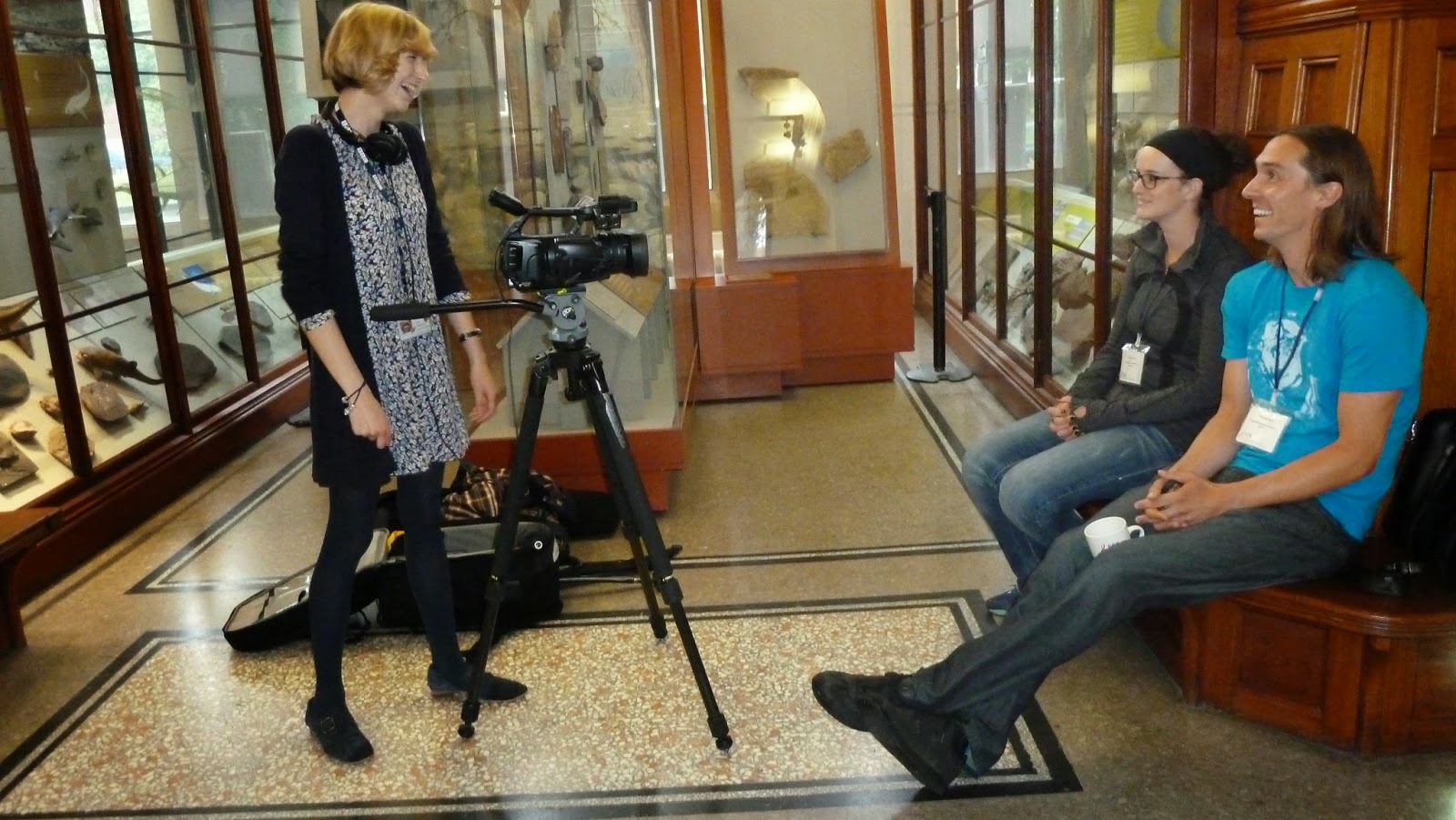
Just then, an email came through; NewsRound were coming!!! Somehow they had picked up on the story about Cichlid fish being able to remember where they were fed twelve days later. I sped down to the reception area to meet Dr Trevor Hamilton and his student Erica Ingraham, who had been told that Vicki Roberts, a reporter for NewsRound was on the way. She turned out to be very friendly and enthusiastic about the work. I felt sorry for her though, lugging a tripod and huge camera through the rain, although she reassured me that she was used to acting as a pack horse. As I asked the conference venue staff if there was a suitably quiet place we could do the interview, they made an inspired suggestion: why not hold the interview in the museum across the road? Fortunately it was near closing time so the main exhibits weren't too busy and Vicki was able to set up her camera under the shadow of Stan the T- Rex ( who apparently is also very popular to officiate at weddings...). We found some suitable 'fish related' artefacts for Dr Hamilton and Erica to pose by as Vicki filmed them answering their questions. It was amazing to see how much kit she could fit in her suitcase; lighting, microphones and a highly technical looking camera. I felt very lucky to be able to watch. After all, I grew up with NewsRound. Could this inspire the next generation of marine biologists?

Afterwards I just had time to change into my dress before the coaches picked us up for the conference dinner. I couldn't believe how suddenly it had come, after all the weeks of wondering if my application would be successful....and here I was, at the end of it all. Our venue? Old Trafford! The first, and possibly the last, time I have stood in a football stadium. Dad will be disappointed it wasn't at the Villa!


The conference was a true showcase of cutting edge research, the Professors and PIs of the future and professional networking. But scientists DO like to let down their hair... As I type this, ABBAs 'Dancing Queen' is belting across the dance floor and the bar is doing a cheerful trade. Having said that, a lot of people are watching the football World Cup on the big screen... After all we have A LOT of nationalities represented here! It's been a wonderful week, exhausting but in all the right ways. I feel so happy to be here but somehow, I don't think I will hold out till the last shuttle bus home at one ' o clock...
Thank you so much , SEB!
Bioinformatics.....it's a scary word for many but as the data sets generated by experimental research become ever more complex, skills in statistical analysis are increasingly valuable in the life sciences. And yet, bioinformatics training remains poorly represented on the university curriculum ( never mind GCSE and A Level!). This session gave an introduction to a new initiative, GOBLET. , which aims to act as a portal for training resources. It certainly makes sense; rather than having isolated training workshops and courses scattered about and not interacting, GOBLET brings these together into an online database which individuals, departments and institutes can sign up for. In small group discussions, the delegates discussed how such a portal could best serve their needs and what training methods they found most effective. And so a paradox emerged: it was felt that bioinformatics should be an established part of undergraduate programmes, yet students who are 'made' to study the subject are much less receptive than those who choose to attend specialist workshops. So should there be a drive to educate students as to the value and importance ( as well as CV enhancing qualities) of data analysis skills? There was also a feeling that, even if scientists receive bioinformatics training, they still lack the confidence to claim competence or teach others. Working through case studies, as a way to practice such skills, or receiving accreditation for completing courses, were suggested as ways to address this.
Fielding more press enquiries
We then moved into the main plenary hall to witness the President's Award ceremony. I was thrilled that Stephanie Johnson, a PhD student at Durham University studying drought resistance in sorghum, own Young Scientist of the Year for the Plant Section. I can't say I was surprised though; I did my final year undergraduate project under Stephanie's supervision so I have seen her diligence and attention to professionalism in action. But it is always nice to have such dedication formally recognised. It is another aspect of the Society for Experimental Biology that really resonates me; the commitment to providing opportunities for early career scientists to showcase their work, gaining recognition and confidence in the process.
In the afternoon, I was sitting in on Sarah Blackford's career sessions as I hoped to cover these for a piece in the SEB bulletin. We were treated to a panel of four speakers who gave an account of their career journeys. Sarah made the interesting point that, whilst 'career' as a noun suggests an ordered progression through life, 'career' as a verb refers more to chaotic, uncontrolled movement! And it was clear from the speakers' accounts that their current position was the result of networking, chance occurrences, happening across advertisements in science journals, unexpected changing priorities ( including babies!) and even disastrous occurrences such as the department burning down. Sarah summarised it perfectly with the quote 'if you want to make God laugh, tell him your plans'. But it was reassuring to find that, even for those who found themselves in a role far removed from what they imagined doing, they still found their jobs rewarding. As Tim Dawkins, head of the Imaging facility at a Durham University, said 'no one sets out to have a technical facilitator'. And yet such people are vital to research and a keystone within the department: take away their skills and expertise and many research projects simply wouldn't happen.
Vicki Roberts from CBBC NewsRound interviews Dr Trevor Hamilton and Erica Ingraham
Just then, an email came through; NewsRound were coming!!! Somehow they had picked up on the story about Cichlid fish being able to remember where they were fed twelve days later. I sped down to the reception area to meet Dr Trevor Hamilton and his student Erica Ingraham, who had been told that Vicki Roberts, a reporter for NewsRound was on the way. She turned out to be very friendly and enthusiastic about the work. I felt sorry for her though, lugging a tripod and huge camera through the rain, although she reassured me that she was used to acting as a pack horse. As I asked the conference venue staff if there was a suitably quiet place we could do the interview, they made an inspired suggestion: why not hold the interview in the museum across the road? Fortunately it was near closing time so the main exhibits weren't too busy and Vicki was able to set up her camera under the shadow of Stan the T- Rex ( who apparently is also very popular to officiate at weddings...). We found some suitable 'fish related' artefacts for Dr Hamilton and Erica to pose by as Vicki filmed them answering their questions. It was amazing to see how much kit she could fit in her suitcase; lighting, microphones and a highly technical looking camera. I felt very lucky to be able to watch. After all, I grew up with NewsRound. Could this inspire the next generation of marine biologists?
Me and Vicki Roberts
Afterwards I just had time to change into my dress before the coaches picked us up for the conference dinner. I couldn't believe how suddenly it had come, after all the weeks of wondering if my application would be successful....and here I was, at the end of it all. Our venue? Old Trafford! The first, and possibly the last, time I have stood in a football stadium. Dad will be disappointed it wasn't at the Villa!
Sorry Dad but it 'aint the Villa! Visiting Old Trafford Stadium
The conference was a true showcase of cutting edge research, the Professors and PIs of the future and professional networking. But scientists DO like to let down their hair... As I type this, ABBAs 'Dancing Queen' is belting across the dance floor and the bar is doing a cheerful trade. Having said that, a lot of people are watching the football World Cup on the big screen... After all we have A LOT of nationalities represented here! It's been a wonderful week, exhausting but in all the right ways. I feel so happy to be here but somehow, I don't think I will hold out till the last shuttle bus home at one ' o clock...
Thank you so much , SEB!
Subscribe to:
Posts (Atom)